

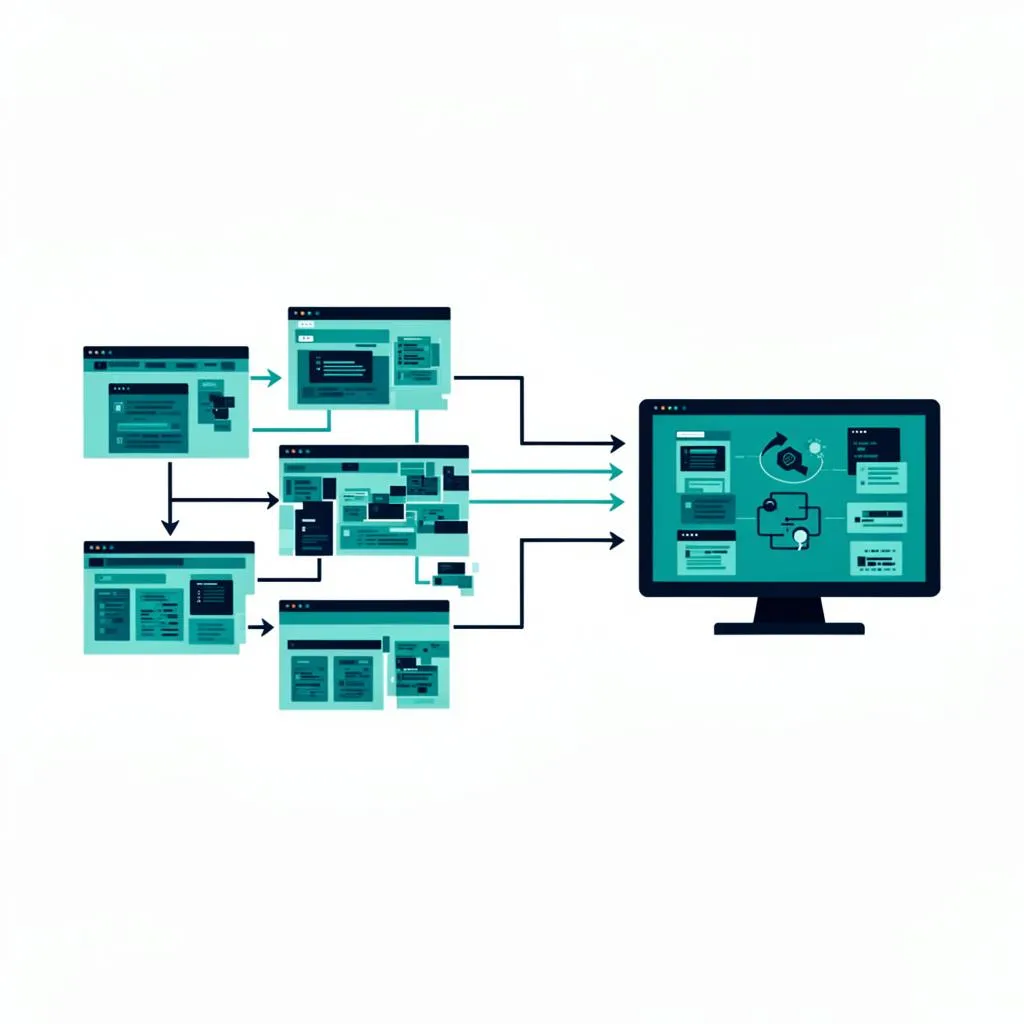
A finance lead’s way of totaling license spend, rework, denials, and privacy risk is in The Real Cost of Software Fragmentation: A Finance View. This post stays with staff time: where people retype the same fact, where an interface fails quietly, and where a survey request means opening several systems.
Where the time goes
The same fact, entered again. Hiring, a credential renewal, a role change, or a discharge can require the same name, date, and identifier in the clinical record, the billing system, the schedule, and a spreadsheet. Each extra entry is a chance to mistype the fact the next system will trust.
Interfaces that fail without a page. When two systems are connected, a change in a field or a code set can stop the feed. Staff often notice when a report disagrees with the chart, not when the interface first breaks. Someone then rebuilds the missing rows by hand.
A new login for each job. Clinicians, billers, and house managers learn a separate screen, vocabulary, and password for each system. Time spent finding the right screen is time not spent on the task the screen was opened for.
Records a surveyor will ask to see together. Policy acknowledgments, training, incidents, and credentials may live in different systems. Pulling them for a survey is a search, then a stack of exports, then a check that the exports describe the same people.
A question that needs more than one system. A director who wants no-show rates beside staffing, or census beside unpaid claims, waits while someone exports each system and lines the rows up. The delay is the cost this post is about. The dollar total of licenses and denials belongs in the finance post.
What published sources measure, and what they do not
HHS’s 2020 strategy on reducing regulatory and administrative burden relating to the use of health IT and EHRs, required by section 4001 of the 21st Century Cures Act, treats clinical documentation for administrative purposes as a source of burden [1]. The report says time spent complying with evaluation and management documentation requirements means clinicians are often unable to finish all required clinical documentation during clinic hours [1]. The report is about health IT burden. It does not count how many applications a behavioral health program runs, and it does not price those applications.
A separate time-and-motion study observed 57 physicians in family medicine, internal medicine, cardiology, and orthopedics in four states [2]. During the office day those physicians spent 27.0% of their time in direct clinical face time with patients and 49.2% on EHR and desk work [2]. The authors’ limitation is that the practices were self-selected and high-performing, and the result may not generalize [2]. The sample is not a behavioral health workforce. Use it as evidence that ambulatory record-keeping already consumes a large share of the clinic day in those four specialties, not as a measure of your program’s overtime.
What to count in your own building
Pick one repeated event, such as an admission or a new hire, and write down each system a person touches and how long that touch takes. Repeat the count for a broken interface and for a survey pull. Those times are your evidence. They are not a national benchmark, and they do not by themselves justify a particular software purchase.
Sources
- Strategy on Reducing Regulatory and Administrative Burden Relating to the Use of Health IT and EHRs, HHS, Office of the National Coordinator for Health IT. Accessed September 28, 2026.
- Allocation of Physician Time in Ambulatory Practice: A Time and Motion Study in 4 Specialties (doi:10.7326/M16-0961), Annals of Internal Medicine. Accessed September 28, 2026.