

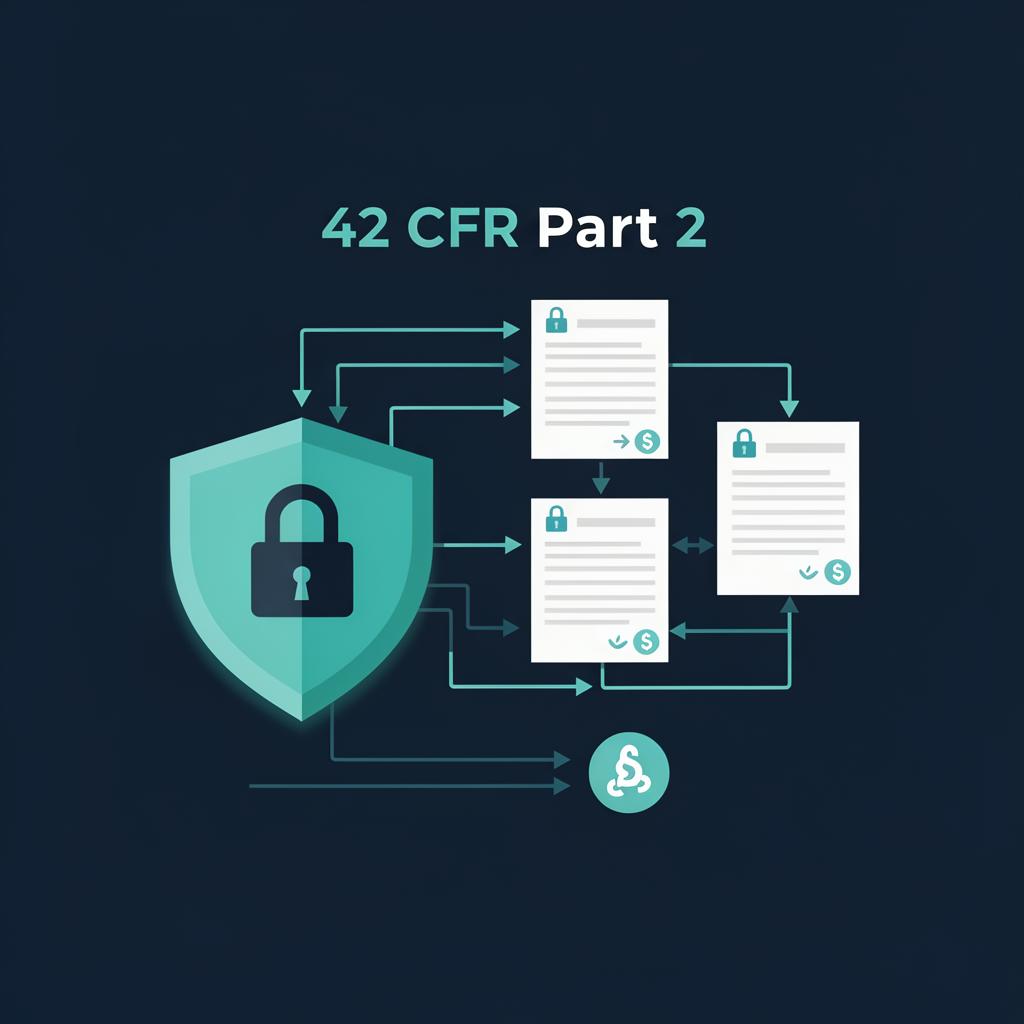
The use and disclosure restrictions in 42 CFR 2.12 apply to a record that would identify a patient as having or having had a substance use disorder, either directly, by reference to publicly available information, or through verification of that identification by another person and that contains substance use disorder information obtained by a federally assisted substance use disorder program after March 20, 1972, or alcohol use disorder information obtained after May 13, 1974 by a federally assisted alcohol use disorder or substance use disorder program, for the purpose of treating a substance use disorder, making a diagnosis for that treatment, or making a referral for that treatment [5]. Information obtained before the pertinent date is covered when a part 2 program maintains it after that date as part of an ongoing treatment episode that extends past that date [5]. A separate restriction bars using substance use disorder information, whether or not it is recorded, to initiate or substantiate criminal charges against a patient or to conduct a criminal investigation of a patient, when a federally assisted substance use disorder program obtained that information after March 20, 1972, or a federally assisted alcohol use disorder or substance use disorder program obtained the alcohol use disorder information after May 13, 1974, for the purpose of treating a substance use disorder, making a diagnosis for the treatment, or making a referral for the treatment [5]. Information obtained before the pertinent date is covered by that restriction when a part 2 program maintains it after that date as part of an ongoing treatment episode that extends past that date [5]. A program is a person, other than a general medical facility, that holds itself out as providing and provides substance use disorder diagnosis, treatment, or referral for treatment; an identified unit within a general medical facility that holds itself out as providing and provides that care; or medical personnel or other staff in a general medical facility whose primary function is that care and who are identified as those providers [3]. It does not cover every organization that treats substance use disorder. Federal assistance is a separate test in § 2.12 [5].
In February 2024, HHS published a final rule that rewrote large parts of Part 2 to bring it closer to HIPAA, as section 3221 of the CARES Act required [2][10]. The rule took effect on April 16, 2024 [2]. Persons subject to it had to comply by February 16, 2026 [2][10].
What changed in 2024
One consent can cover treatment, payment, and health care operations. When the consent is a single consent for all future uses and disclosures for treatment, payment, and health care operations, a Part 2 program, covered entity, or business associate may use and disclose those records for treatment, payment, and health care operations as the HIPAA regulations permit, until the patient revokes the consent in writing [4]. A consent disclosure to a central registry must still meet § 2.34, and a consent disclosure in connection with a criminal justice referral must still meet § 2.35 [4].
A recipient under that consent does not have to segregate the records. A Part 2 program, covered entity, or business associate that receives records based on a single consent for all treatment, payment, and health care operations is not required to segregate or segment those records [5].
A treatment, payment, and operations redisclosure does not authorize proceedings against the patient. When records are disclosed for treatment, payment, and health care operations to a covered entity or business associate, that recipient may redisclose them as the HIPAA regulations permit, except for uses and disclosures in civil, criminal, administrative, and legislative proceedings against the patient [4]. When the records are disclosed with a consent given once for all future treatment, payment, and health care operations to a Part 2 program that is not a covered entity or business associate, the recipient may further disclose the records consistent with the consent [4]. When the records are disclosed for payment or health care operations to a lawful holder that is not a covered entity or business associate, that holder may further disclose them as necessary for its contractors, subcontractors, or legal representatives to carry out the payment or health care operations named in the consent on behalf of that holder [4]. A lawful holder that rediscloses that way must have a written contract or comparable legal instrument with the contractor or voluntary legal representative, which provides that the contractor, subcontractor, or voluntary legal representative is fully bound by this part upon receipt of the patient identifying information [4]. In making that redisclosure, the holder must give the notice required by § 2.32, must require appropriate safeguards against unauthorized uses and disclosures, and must require a report of any unauthorized use, disclosure, or breach of patient identifying information to the holder [4]. The holder may redisclose only the information necessary for that recipient to perform its duties under the contract or comparable legal instrument [4]. The contract may not let a contractor, subcontractor, or voluntary legal representative redisclose to a third party unless that third party is a contract agent of the contractor or subcontractor, helping provide the services described in the contract, and only as long as that agent further discloses the information only back to the contractor or the lawful holder from which the information originated [4]. The patient’s consent, the limited crime report in § 2.12(c)(5), or a court order under § 2.64 or § 2.65 can authorize use in a proceeding against the patient [6]. A consent to use or disclose records, or testimony relaying the information in a record, in a civil, criminal, administrative, or legislative investigation or proceeding cannot be combined with a consent to use and disclose a record for any other purpose [11]. Each disclosure made with written consent must carry one of the notices in § 2.32, and a copy of the consent or a clear explanation of its scope [6].
SUD counseling notes need their own consent. Section 2.11 defines SUD counseling notes as notes recorded, in any medium, by a Part 2 program provider who is a substance use disorder or mental health professional, documenting or analyzing the contents of conversation during a private substance use disorder counseling session or a group, joint, or family substance use disorder counseling session, and separated from the rest of the patient’s SUD and medical record [3]. The definition excludes medication prescription and monitoring, counseling session start and stop times, the modalities and frequencies of treatment furnished, results of clinical tests, and any summary of diagnosis, functional status, the treatment plan, symptoms, prognosis, and progress to date [3]. Section 2.31 requires a separate consent for any use or disclosure of those notes, except for use by the originator for treatment; use or disclosure by the program for its own training programs in which students, trainees, or practitioners in substance use disorder treatment or mental health learn under supervision to practice or improve their skills in group, joint, family, or individual substance use disorder counseling; use or disclosure by the program to defend itself in a legal action or other proceeding brought by the patient; and the other exceptions that section lists [11]. A broad consent for treatment, payment, and health care operations does not authorize those notes [11]. A written consent for those notes may be combined only with another written consent for those notes. The program may not condition treatment, payment, enrollment in a health plan, or eligibility for benefits on a consent for those notes [11].
Breach notification follows the HIPAA breach provisions, for a Part 2 program’s unsecured records. Section 2.16 requires a Part 2 program, and any other lawful holder of patient identifying information, to have formal policies and procedures to reasonably protect against unauthorized uses and disclosures of patient identifying information and to protect against reasonably anticipated threats or hazards to the security of patient identifying information [7]. Family, friends, and other informal caregivers who are lawful holders are not required to comply with that requirement [7]. For paper records, those policies must address transfer and removal; destruction, including sanitizing the hard-copy media associated with the paper printouts so the patient identifying information cannot be retrieved; maintaining the records in a secure room, locked file cabinet, safe, or other similar container, or storage facility, when they are not in use; using and accessing workstations, secure rooms, locked file cabinets, safes, or other similar containers, and storage facilities that use or store the information; and de-identification under 45 CFR 164.514(b) so there is no reasonable basis to believe the information can be used to identify a particular patient [7]. For electronic records, they must address creating, receiving, maintaining, and transmitting the records; destruction, including sanitizing the electronic media on which the records are stored so the patient identifying information cannot be retrieved; using and accessing electronic records or other electronic media that contain patient identifying information; and de-identification under 45 CFR 164.514(b) so there is no reasonable basis to believe the information can be used to identify a patient [7]. It also applies 45 CFR part 160 and subpart D of 45 CFR part 164 to a Part 2 program, for breaches of unsecured records, in the same manner as those provisions apply to a covered entity’s breaches of unsecured protected health information [7]. That is a security-policy and breach-notification duty. It is not a rule that every view of a record be written to a log.
Penalties and complaints follow the HIPAA enforcement authorities. Any person who violates any provision of 42 U.S.C. 290dd-2(a) through (d) is subject to the penalties in sections 1176 and 1177 of the Social Security Act, 42 U.S.C. 1320d-5 and 1320d-6 [8]. A person acting for an investigative agency with jurisdiction over a Part 2 program or another record holder, including an employee or agent of that program or record holder, does not incur civil or criminal liability under 42 U.S.C. 290dd-2(f) for a use or disclosure inconsistent with this part that occurs within the scope of employment while investigating or prosecuting the program or record holder, when that person shows the diligence and later-use conditions in § 2.3(b) [8]. Enforcement of noncompliance with Part 2 follows 45 CFR part 160, subparts C, D, and E, in the same manner those provisions apply to covered entities and business associates for noncompliance with 45 CFR parts 160 and 164 [8]. A Part 2 program must provide a process to receive complaints about the program’s compliance with Part 2 [9]. A person may file a complaint with the Secretary, for a violation by a Part 2 program, covered entity, business associate, qualified service organization, or lawful holder, in the same manner as a complaint under 45 CFR 160.306 [9]. The program may not intimidate, threaten, coerce, discriminate against, or otherwise retaliate against a patient for exercising a right under this part or for taking part in a process this part provides, including filing a complaint under § 2.4 or § 2.3(c) [9]. It may not require a patient to waive the right to file a complaint under § 2.4 or § 2.3 as a condition of treatment, payment, enrollment, or eligibility for any program subject to this part [9].
An accounting of disclosures has a later compliance date. Section 2.25 adds a right to an accounting of disclosures made with consent, covering up to three years before the request [2]. A separate provision covers treatment, payment, and health care operations disclosures made through an electronic health record [2]. The compliance date for § 2.25 is tolled until 45 CFR 164.528 is revised to address accounting for those electronic-record disclosures [2]. Do not treat that accounting as a duty that is already in force.
What did not change
The restrictions do not apply to communications of information between or among personnel having a need for the information in connection with their duties that arise out of the provision of diagnosis, treatment, or referral for treatment of patients with substance use disorders, if the communications are within a Part 2 program or between a Part 2 program and an entity that has direct administrative control over the program [5]. Patient identifying information may be disclosed to medical personnel to the extent necessary to meet a bona fide medical emergency in which the patient’s prior written consent cannot be obtained, or to meet a bona fide medical emergency in which the program is closed and unable to provide services or obtain that consent, during a temporary state of emergency declared by a state or federal authority as the result of a natural or major disaster, until the program resumes operations [12]. Immediately following the disclosure, the program must document it in writing in the patient’s records, including the name of the medical personnel to whom disclosure was made and their affiliation with any health care facility, the name of the person making the disclosure, the date and time of the disclosure, and the nature of the emergency, or the error if the report was to the Food and Drug Administration [12]. The restrictions do not apply to communications from Part 2 program personnel to law enforcement agencies or officials that are directly related to a patient’s commission of a crime on the premises of the Part 2 program or against Part 2 program personnel, or to a threat to commit such a crime, and that are limited to the circumstances of the incident, including the patient status of the individual committing or threatening to commit the crime, that individual’s name and address, and that individual’s last known whereabouts [5]. They also do not apply to the reporting under state law of incidents of suspected child abuse and neglect to the appropriate state or local authorities [5]. The restrictions continue to apply to the original substance use disorder patient records maintained by the Part 2 program, including their use and disclosure in civil or criminal proceedings that may arise out of the report [5].
What this means for your systems
Software can help a program apply these rules. It does not satisfy them on the program’s behalf. The practical requirements are:
- A written consent may be paper or electronic and must include the elements in § 2.31: the patient’s name; the name or other specific identification of the person or class authorized to make the use or disclosure; a description of the information that identifies it in a specific and meaningful way; the recipient; each purpose; the patient’s right to revoke the consent in writing, except to the extent that the part 2 program or other lawful holder of patient identifying information that is permitted to make the disclosure has already acted in reliance on it, and how the patient may revoke it; an expiration date or event that relates to the patient or the purpose; the patient’s signature and, when required, the signature of a person authorized to give consent under § 2.14 for a minor, or under § 2.15 for a patient who has been adjudicated as lacking the capacity to make their own health care decisions or who is deceased; and the date signed [11]. Electronic signatures are allowed unless another law prohibits them [11]. If the recipient is an intermediary, the consent must name the intermediary and either name its member participants or give a general designation of a participant or class of participants, limited to a participant who has a treating provider relationship with the patient [11]. For a single consent covering future treatment, payment, and health care operations, the recipient may be described as the patient’s treating providers, health plans, third-party payers, and people helping to operate the program, or a similar statement, and the purpose statement “for treatment, payment, and health care operations” is sufficient [11]. For that consent, “end of the treatment,” “none,” or similar language is a sufficient expiration, and for research, “end of the research study” or similar language is sufficient [11]. If the program will use or disclose the records to fundraise on its own behalf, the consent must state the patient’s right to elect not to receive any fundraising communications [11]. A consent for treatment, payment, and health care operations must also state that a recipient may redisclose the records and that they may no longer be protected by Part 2, the consequences of refusing to sign, and, when the recipient is a covered entity or business associate, that redisclosure follows the HIPAA regulations except for proceedings against the patient [11]. A disclosure may not be made on a consent that has expired, that on its face substantially fails those elements, that is known to have been revoked, or that the record holder knows, or by reasonable diligence could know, is materially false [11].
- Honor a written revocation, except to the extent the program or another lawful holder that is permitted to disclose has already acted in reliance on the consent [11].
- Attach the § 2.32 notice, and a copy of the consent or an explanation of its scope, to every disclosure made with consent [6].
- Keep SUD counseling notes apart from the rest of the record, because the definition requires that separation and a general treatment, payment, and health care operations consent does not release them [3, 11].
- Include unsecured Part 2 records in the breach process that § 2.16 applies to a Part 2 program [7].
Encore OS is designed toward these requirements. It captures Part 2 consent with redisclosure tracking. The Trust page names the Part 2 mechanisms.
Sources
- 42 CFR Part 2: Confidentiality of Substance Use Disorder Patient Records, eCFR, Office of the Federal Register. Accessed September 28, 2026.
- Confidentiality of Substance Use Disorder (SUD) Patient Records (final rule, 89 FR 12472), HHS, Federal Register. Accessed September 28, 2026.
- 42 CFR 2.11: Definitions, eCFR. Accessed September 28, 2026.
- 42 CFR 2.33: Uses and disclosures permitted with written consent, eCFR. Accessed September 28, 2026.
- 42 CFR 2.12: Applicability, eCFR. Accessed September 28, 2026.
- 42 CFR 2.32: Notice and copy of consent to accompany disclosure, eCFR. Accessed September 28, 2026.
- 42 CFR 2.16: Security for records and notification of breaches, eCFR. Accessed September 28, 2026.
- 42 CFR 2.3: Civil and criminal penalties for violations, eCFR. Accessed September 28, 2026.
- 42 CFR 2.4: Complaints of noncompliance, eCFR. Accessed September 28, 2026.
- Fact sheet on the 2024 Part 2 final rule, HHS. Accessed September 29, 2026.
- 42 CFR 2.31: Consent requirements, eCFR. Accessed September 28, 2026.
- 42 CFR 2.51: Medical emergencies, eCFR. Accessed September 28, 2026.